
The constant murmur of the metropolis died the moment the heavy double doors fell shut behind them. No birds could be heard anymore, no clattering of carts on cobblestone, no humming of airships tracing their paths across the sky. Only silence.
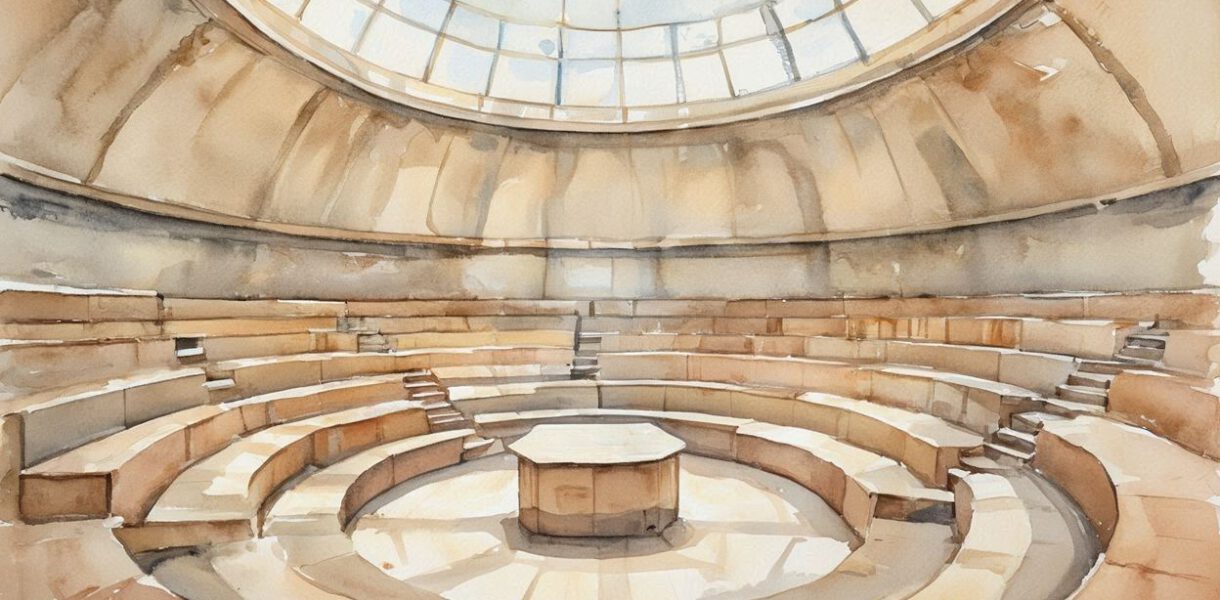
Finn stopped and blinked into the sudden brightness. The chamber of the Central Council of the Cloud Islands opened before them in a wide semicircle; above, a high hall rose, filled with light and air. Everything lay open. The walls were not made of masonry but of smooth, seamlessly joined sandstone, gleaming pale like the belly of a dead fish. The light bounced from it, dancing across the surfaces and making the space seem even larger and brighter than it already was. Finn’s first thought was that someone here must have forgotten to finish the roof and, in desperation, had made do with a giant goldfish bowl. Behind the mighty dome of glass and slender metal ribs, clouds drifted past — slow and soundless — sometimes so near they dimmed the room for a few seconds, then drifting away again, faint and translucent. Benches descended in gentle steps toward the center, open, without backs or railings, each arranged so that you could see everything from wherever you sat — and were seen by everyone. There were no corners here, no dark recesses to hide in. Whoever sat in this place was always visible. At the very center lay a simple circle of polished floor — the speaker’s place, the presentation plate, where one had to turn on oneself, facing all and forever feeling someone’s eyes on one’s back.
As they approached the rows of seats, already filled with many council members, Finn wondered why this hall felt so wrong to him. First, he noticed the wind. A steady, cool draft moved through the chamber — different from the wild, honest gusts of the storm zones. It was stealthy, annoying, tugging at his collar, creeping coldly down his neck, never letting him quite settle. Finn inhaled, sniffed — and grimaced. It smelled of nothing. Absolutely nothing. Where Nimbusheim smelled of smoke, roasted meat, airship fuel, and dust, here there was only cold stone. Sterile. Dead. Finally, he realized what else unsettled him: the color — or rather, the lack of it. Everything was beige and light gray, even the robes of the council members. They sat so still that the folds of their garments were barely distinguishable from the stone beneath them — some could easily have passed for statues, given their pallid faces. Something occurred to Finn, and he leaned toward Eva to whisper in her ear: “If you sit here long enough, do you become part of the furniture?”
But the words did not stay between them. The moment they left his mouth, the curved walls caught them, amplified them, and carried them — clear as crystal — through the entire room. He had whispered, but he might just as well have shouted into a megaphone. Every council member turned their head in perfect unison. Finn froze. Heat rushed to his face. Eva showed no reaction, though he caught the flicker of a reproving smile at the corner of her eyes.
From the circle of assembled delegates, an angry voice rose. “By the pow-ER of the CEN-tral COUN-cil of the CLOUD Is-lands, I de-MAND im-ME-di-ate SI-lence!” The chairperson was dressed no differently from the others; only a small hourglass at his side and a wooden gavel marked his authority. He seized it and banged it against the stone bench to demand order. His speech was shrill and jerky, accenting random syllables theatrically so that it sounded as if he were speaking from the back of a bucking horse. Finn heard Corwin choke back a laugh and noticed Eva’s sharp glance silencing him.
“We must con-TIN-ue at LAST!” shouted the chairperson, eyes flashing. A murmur rippled through the council, but he instantly raised his hand. “The HEAR-ing of the hon-OR-able Airis of Windhold, in-vest-i-ga-TOR of the Pi-lots’ OR-der, will CON-tin-ue — NOW! Please, speak ON!”
Eva, Finn, and Corwin sank as quietly as possible onto a bench to follow the proceedings. With them, the lords of the League of Free Cities had entered and now spread out across the upper rows like a flock of crows. In their black robes, they seemed out of time in the sterile air of the chamber. But Eva’s gaze stayed fixed on Airis — her old friend, whose life had hung by a mere thread not long ago. She looked tired and worn, but otherwise unharmed. As relieved as Eva was to see her alive, she was equally confused. Why had the pirates released her? Why was she here? What was this all about? Her Grand Master of Reconnaissance had not noticed her, despite Finn’s blunder; Airis was fully focused on the chairperson and visibly nervous.
Airis hesitated, then resumed. “As I have already stated, honorable Council,” she began, her voice carefully composed, “my expertise lies primarily in flight engineering. Yet even I, without specialized theoretical knowledge, can interpret the documents that came into my possession.”
“May we see these documents?” one of the delegates asked. Airis nodded and lifted a bundle of papers. The chairperson clapped his hands. “Chamber TECH-ni-cian! The HO-lo-GRAM!” A stout man, who had discreetly lingered at the edge, hurried forward and nearly tripped over the steps. Taking the documents with a small bow, he hurried off, and moments later a hologram of the plans shimmered in golden light across the dome. Precise lines, measurements, cross-sections of a device that looked at first like a meteorological station. Eva heard the men beside her gasp. They exchanged startled glances but dared not speak. The members of the Guild sat motionless — if they recognized the device or felt alarm, none showed it.
“These plans depict a mechanism that can actively interfere with existing air currents,” Airis said. She gestured sharply at one section. “Here — a resonance core. And here, control fins that modulate thermals. The apparatus amplifies and aligns natural vortices, stabilizing and strengthening certain flight corridors.” She left the words to hang. Corwin’s mouth fell open. How does she know that? he mouthed toward Eva, who only shrugged helplessly.
“The result,” Airis continued, “is accelerated, reliable transit routes — especially for heavy freighters. Flight times are reduced. Energy use decreases. Losses from detours or delays vanish.” Her tone remained measured, almost clinical. “The documents I hold name the League of Free Cities as both commissioner and operator of these installations.” Some council members leaned forward, others cast intrigued glances toward the guild representatives. Volkward, conspicuous in his blood-red robe, crossed his arms across his chest.
“I am no atmospheric physicist and no jurist,” Airis concluded, “but to my understanding, the deployment of these devices violates existing law.” She pointed again at the plans. “Specifically, Article 3 of the Sovereignty Charter of the Cloud Islands.” Her voice grew firmer as she quoted: “Natural air currents above any Cloud Island are considered part of its sovereign domain and may neither be artificially generated, amplified, nor redirected.” She paused. “The documented manipulations occur directly over Goldendale,” she continued, “without the local administration’s knowledge.” Some of the council exchanged glances.
“Moreover,” Airis said, “I believe this also constitutes a breach of Paragraph 16 of the Charter of Free Aviation.” She quoted again: “No one shall alter airflows in a manner that affects civilian or military aircraft without disclosure of the controlling source.” Turning slowly in a circle, she made eye contact with all present. “I ask this Council to draw the obvious conclusion,” she finished. “I have shown that existing law is being violated — apparently by the League of Free Trade Cities.”
A murmur spread through the chamber, quickly silenced by the chairperson’s sharp blows of the hammer. “Does ANY-one have QUEStions?” — “I do,” came Volkward’s low voice. Rising from his seat — unnecessarily, given the hall’s acoustics — he asked, “Honored lady, would you be so kind as to reveal the provenance of these documents? How did they come into your possession?”
“I cannot disclose the source of my evidence,” Airis replied. A stronger murmur swelled. “Not because it is unreliable,” she added, “but because revealing it would endanger others.” Some councilors protested, others stared motionless as the weight of her words settled in. The chairperson raised the hammer once more, striking more slowly now, with emphasis. “The CEN-tral COUN-cil takes NOTE,” he shrilled, “that the wit-NESS can-NOT dis-CLOSE her SOURCE. This is STAN-dard PRO-CE-dure!”
Eva felt her stomach tighten. Cannot, she thought. Or must not? She looked at Airis. Her friend stood straight, shoulders square, chin slightly raised. She appeared calm and composed now that she had finished her statement — but Eva, who knew her, saw the subtle tension: tightly clasped hands, shallow breath, the brief hesitation before she raised her gaze again. Eva’s eyes swept across the benches — over the impassive faces of the council members, the restrained composure of the guild delegates. And then — on the far side, where the audience was seated — her gaze caught.
A young woman in the plain garb of a novice sat there, a thin metal-framed pair of glasses on her nose, a notebook on her knees in which she scribbled intently. A cap covered her head, but a treacherous strand of light-blond hair had slipped free and fallen onto her shoulder. Vaska. She looked up from her notes; their eyes met — and the pirate smiled.
Eva’s heart skipped a beat, then fury surged through her. The puzzle pieces locked together with brutal clarity. Airis was not here of her own will. She was here because she was being blackmailed. Eva felt as though the ground were giving way beneath her feet. What should she do? Let her friend continue? Expose her?
Airis’s voice rang out again, stronger now. “I am fully aware of the gravity of my words,” she declared. “And I am prepared for doubts to be raised about my statement. Therefore, I do not say this lightly. I pledge,” — her words echoed through the vast chamber — “upon the good name of the Conclave Aeris Fidelium, to the truth of my testimony.”
At that moment, Eva stepped forward. “No.”