
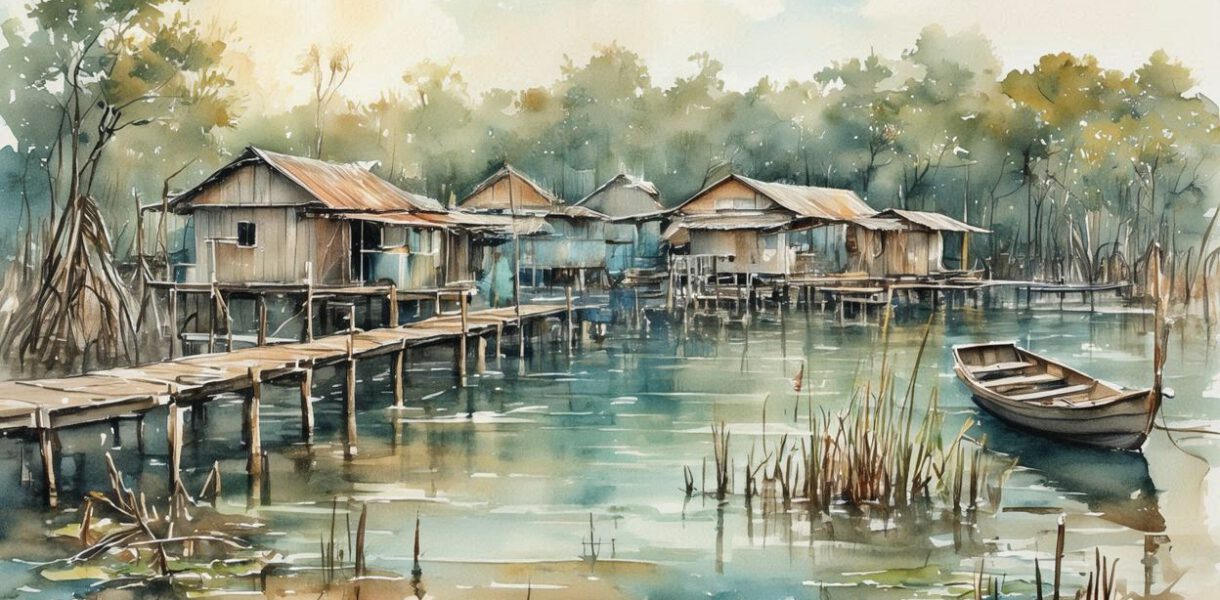
The ground beneath Airis’ boots yielded softly with every step. Dark water shimmered between the roots of tall trees, and the mangrove forest closed around the narrow path like a damp curtain as the cartographer walked ahead of her. The air was heavy, warm, and smelled of rot. Mosquitoes danced in dense swarms, their annoying buzzing hanging in the air like a thin veil.
“Punta Verde,” said the cartographer, as if the name explained anything at all. When the young woman did not reply, he turned around. “In the local tongue of the land, it simply means ‘green point’.” Airis brushed a damp strand of hair from her face. The rainforest they had encountered in the hinterland of the pirate city of Sangresol puzzled her. She had expected the typical vegetation of the pirate isles—rocks, sharp cliffs, scorched earth that bore witness to how the inhabitants ruthlessly squeezed every resource from their homeland. But where did the lush mangrove forest and the swamps come from? The cartographer seemed to notice her astonishment. “La Vergüenza is… wilful,” he said with a smile. “There are many natural springs here. And it lies lower than most of the Cloud Islands. The water can collect; nothing really drains away.” A droplet loosened itself from a leaf and hit Airis on the neck—an unpleasant sensation.
After one last bend, the forest opened abruptly. Before them lay a lake, and on it a village that clung more badly than well to stilt houses above the shallow water. The buildings jutted into the air at crooked angles and were connected by narrow walkways. To her surprise, Airis saw that at one of the jetties boats were moored that were suited for travel both on the water and in the air. “The Griffon’s Nest,” the cartographer announced with unhidden pride.
The closer they came, the more details emerged. On the walkways, figures of every kind milled about: armed men and women, card players, mechanics with oil‑stained hands, people who eyed them with open suspicion. Nowhere did she see any flags but the lone black one on which a silver griffon reared up, ready to strike.
“What flag is that?” she asked. “That is the Silver Griffon,” the cartographer explained. “A symbol of our leader. Although—I should probably not say that too loudly. The others don’t like to hear that word. Let’s put it this way: the Griffon is the authority we currently follow.” He hesitated for a moment. “We are only united for a time—myself included.”
“For a time?” Airis looked at him.
“Everyone you see here bows to no flag and to no lord—unless it serves a greater good.”
“And what is this greater good?”
The cartographer smiled again, this time evasively. “You will find out soon enough. Come on, let’s go.”
Before Airis could say anything, he led her along one of the walkways to a freestanding wooden structure at the edge of the village. Rough‑hewn beams supported a metal apparatus of gears, coils, and tangled conduits that immediately fascinated Airis. If Ottilie were here, shot through her mind, or Corwin—those two would have had a field day with this thing. The cartographer stepped closer and laid his hand on one of the metal rings. “We found it in Goldendale,” he said. “In an old guild warehouse. It was well hidden. We knew at once this could not be a coincidence. We took it apart piece by piece and brought it here. Since then we’ve been trying to put it back together. But even incomplete, we understood what it does—for we’ve seen its effect on Goldendale.”
“What does it do?” Airis asked. Her interest in the strange mechanics now outweighed her reservations about the old pirate. He looked at her as if weighing how much truth he could ask her to bear. Then he answered, “It manipulates the wind.”
Airis frowned. That in itself was nothing extraordinary. On the Cloud Islands, countless techniques existed to tame the unpredictable breath of Zephyros. Why were the pirates making such a fuss about it? He noticed the look on her face. “We are not talking about just any wind,” he clarified, “but a powerful seasonal mass current. Heat, ground moisture, and air movement—all of it is bound together within it. The people of Goldendale call it the Rye Wolf and believe in a spirit that runs through their fields. Of course, that is mere superstition.” The cartographer laughed derisively. “Normally, this current only forms late in the year, at harvest time. Even though it cuts swaths through the grain and the farmers curse it, its effect is positive—indeed, it is mainly responsible for the mild climate of the isle. The current brings even moisture and keeps the temperatures stable.” He pointed at a bundle of coils. “But the guild has been interfering for some time now. For years we have been observing that they have unleashed the Rye Wolf permanently.”
“Why would anyone do that?” Airis asked in astonishment.
“Well,” he replied, “think about whose hands control the transport of goods from Goldendale. If I know where the current flows, and can even reinforce it, my ships fly with less fuel and in less time. That pays off—as long as I do not pass the lowered costs on to the producers.”
Airis’ fists clenched. “So you are saying the League of Free Cities is exploiting the farmers of Goldendale.”
“That is correct,” said the cartographer. “And that is not all. Since the manipulation began, winter has come to Goldendale earlier every year. Whatever is still harvested disappears into the holds of merchant ships—not onto the plates of the people.”
She studied the apparatus thoughtfully. How can anyone be so cruel, shot through her mind. Goldendale had always been an isle that lived from agriculture. There was no great wealth there. The little the farmers produced was barely enough to live on.
“Just so you know,” the cartographer said at last, almost casually. “I am here only out of scientific interest. The possibility of influencing such a complex current in a controlled way is unique. It would be negligent to leave this knowledge in the hands of the guild alone.”
“And the other pirates?” Airis asked. “You cannot tell me they all have a ‘scientific interest’. That Vaska is no better than a hired assassin. What does your group want?”
The cartographer’s smile turned crooked. “We have joined the Silver Griffon to break the dependence of the Cloud Islands on the merchants’ guild. Goldendale is to be freed—but it is only the beginning.”
Airis’ gaze left the apparatus only reluctantly. “You talk of liberation,” she said at last, “but the pirates also attacked Goldendale.” For a brief moment she saw something flare in his eyes, but before she could grasp what it was, it was gone.
“‘Attacked’ is a big word,” he countered. “We struck at the harbor district. Nothing more.”
“There is hardly anything more important,” she protested. “The harbor is the heart of the isle!”
“Well, precisely for that reason—the guild’s warehouses, their loading platforms, their checkpoints,” he said. He made a dismissive gesture. “Hardly any civilian areas. It was a targeted strike, nothing more.”
A frown creased Airis’ brow. “I can barely remember anything because of the crash,” she said thoughtfully, “but I saw fire.”
“Yes,” the cartographer admitted. “But only where the guild had its fingers in the game.” His gaze remained calm, almost regretful. “We spared the villages. The fields as well.”
A soft crack ran through the wood beneath their feet. Somewhere nearby, someone burst out laughing. “We do not have much time left,” the cartographer began, clearly eager to change the subject. “You have seen the mechanism now. You know what the guild is capable of. Now we need you to make us heard. You must bring charges on behalf of the Order.”
Airis folded her arms. The wind from the forest carried the smell of wet mud to them. “For that, you would need the Grand Master. Besides, the Order does not interfere in trade wars.”
“This is no trade war.” He lifted his head. “It is exploitation—systematic exploitation. And it only works because no one lays the connections bare. I ask no more of you than this: stand before the Central Council of the Cloud Islands and present the evidence. I have drawn wind charts and schematics of the apparatus. That should suffice. But if I go myself, no one will believe me.”
Airis fell silent. “You ask a lot,” she said at last.
“All we ask is that you mediate,” he replied calmly. “That you explain what is happening here—and that the Order formally indicts the guild.”
The tiniest hesitation. “Then you too have chosen to look away.”
She turned away and walked a few steps along the walkway. The water gurgled beneath her. Something stirred inside her, something uncomfortably familiar. She knew this feeling: that faint tug in her gut that injustice awoke in her—the urge to do something about it at once.
“One thing you should understand,” she said without turning around. “I will not lie. I will not sugarcoat anything. Least of all your part in it.”
“That is not what I expect,” the cartographer replied at once.
If they are right, Airis thought. If the guild truly… She sighed. The truth, she thought, probably lies somewhere in between.
“I will do it,” she said finally—and was a little startled at how steady her voice sounded. “But not because I trust you. I will do it because, when I was sworn into the Order, I vowed to protect the people of the Cloud Islands by any means necessary.”
The cartographer inclined his head, and a smile flitted across his lips. He offered her his hand. She hesitated for a heartbeat, then took it.