
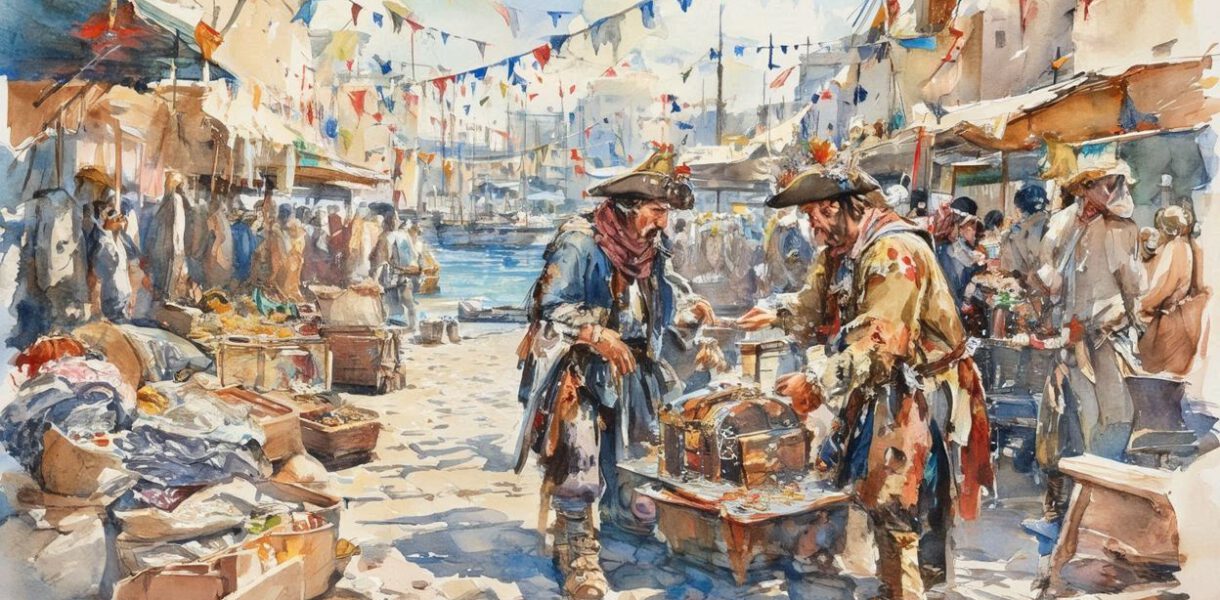
She woke to the sound of human and animal noises.
It was a many‑voiced murmur, clucking, buzzing, and neighing, laced with laughter, quarrels, the clinking of coins, and, far away, the rhythmic pounding of a blacksmith’s hammer. For a fleeting moment she thought she was still dreaming. What was that? It sounded like a marketplace. She opened her eyes. Above her stretched coarse canvas sailcloth, patched several times and fastened with ropes. The light filtered through it softly, bathing everything in a warm yellow. The ground beneath her was hard and dusty, yet someone had placed a blanket underneath her. Only now did she notice her wrists were tied with a rope.
Airis pushed herself upright. Indeed, she was on a market square. Booths stood tightly packed, offering a curious assortment of goods: crates of dried meat, knives of all sizes, spare parts for gliders, cages crammed with spotted rabbits, maps, jewelry, sacks of ripe apples. Behind the stalls she saw the masts of large sailing ships — a landing site had to be nearby. It could have been any harbor city on any of the Cloud Islands, if not for the air pirates everywhere, going about their business in their own eccentric outfits, chatting, haggling noisily, and hauling goods through the narrow lanes between the stands. Many noticed her sitting there, bound under the canvas, but no one seemed to care. Some threw her a bored glance and moved on; others lingered, their eyes glinting with such greedy curiosity that a chill ran down her spine.
“Ah, you’re awake,” said a deep, calm voice nearby. An older man stepped forward and dropped onto a low crate, legs apart. He carried no weapons — at least none openly — just ragged trousers, a knitted sweater, and over it a vest with countless tiny pockets. From them protruded pencils, compasses, rulers, and all manner of objects whose purpose and function Airis couldn’t guess.
“Where am I?” she asked, clearing her throat; her voice was rough from long silence.
“This must all be very exciting for you,” he replied. “But fine, you might as well know. We’re here in Sangresol, on—” “La Vergüenza!” gasped Airis. The shock was written plainly on her face. “Yes, indeed,” he said soothingly. “No need to lose it.” Oh, but there was, thought Airis — finding herself on one of, if not the most infamous pirate island was certainly reason enough to lose it.
Desperately, dear reader, you glance at this accumulation of foreign names for places you’ve never heard of before, mentally flip back a few pages, and wonder whether you skipped a crucial paragraph somewhere. No, you’ve missed nothing. We’ve simply taken a sudden change of setting in our story — allow me this narrative trick by which I’ve whisked you away without warning from the comfortable Eldbridge campus into the rough surroundings of a pirate town. But worry not: you can count on me as your faithful guide, who will lead you safely — currently through one of the less glorious corners of the Cloud Islands — and who would, as usual, discreetly stay in the background, if not for the fact that once again you require my guidance before you despair at the abundance of exotic names or lose track of the story’s interesting history altogether.
“What now is this La Vergüenza?” you wonder. The name means “The Shame.” But the island did not always bear that title. Once, the landmass — floating far from all other Cloud Islands and unusually close to the ground — had a far more harmless name: Quincena. “Fifteen Days,” the ground‑dwellers called it, for that was exactly how long the journey there took: fifteen days through open sky, with no landing point, no plan B. Run out of fuel on the way, and that was that. That alone should have served as warning. Those not deterred by that were taught better by the unpredictable air currents and treacherous pressure shifts around the island. Quincena was never an inviting or comfortable place. But that made it extremely practical — because, as human nature dictates, people like to use uncomfortable places for uncomfortable people.
For a long time, Quincena served the ground‑bound government as a prison, an exile, a hiding place, and a dumping ground for everyone they no longer wanted to see but could not publicly condemn. They sent them up, provided the bare necessities, and largely left them to themselves. Guards? None were needed — the island’s conditions took care of that. Escape was impossible.
The tragedy began during an especially harsh winter. Famine struck large parts of the lands below, caused by failed harvests and political mismanagement. The people rose up and blamed their elites. There were revolts, lootings, assassinations, mass panic — well, you know how it goes, dear reader. To keep power from slipping away, the government had to act. Within a few weeks, instead of the occasional exile per month, hundreds of people were sent to Quincena: political opponents, troublesome thinkers, revolutionaries, entire families labeled as “compromised.” Officially this was called “resettlement.” Unofficially, it was exactly what it looked like.
Then came the catastrophe — a massive low‑pressure system that completely cut the island off from the ground and made any approach impossible. Days passed, then weeks. When contact was finally attempted again, there was no answer. The Ground sent an expedition, dutifully, but far too late. What they found there — history keeps silent. The government tightly sealed all reports. What could not be contained, however, were the stories from daring travelers who later reached the island. They spoke of names carved into walls, tally marks counting days and rations, and graves. Officially, the ground declared Quincena uninhabitable, too dangerous to maintain. Unofficially, everyone knew what had happened. And so the island received its new name — La Vergüenza, The Shame.
What happened there was the last recorded attempt by the people of the ground to establish themselves in any way on the Cloud Islands. After that, such efforts ceased. Even the other islands wanted nothing to do with their dangerous, distant sister. The island remained abandoned — a half‑forgotten place, soon left off maps entirely, fading into twilight, half myth, half legend.
And then, my esteemed reader — well, then came the pirates. They found a land that belonged to no one. In the half‑collapsed buildings they set up camp, cleared the overgrown streets, reactivated the supply networks and the harbor. They rebuilt the island’s largest settlement into what is now known as Sangresol and declared it the capital. Their swift ships traverse the fifteen‑day distance and the turbulent currents far faster and safer than the average trade cruiser, making La Vergüenza the perfect base. Well-knwon pirate islands like Bloody Bay or Seaguard may be sung of in sagas and marked reverently on maps, yet none exerts that peculiar allure that La Vergüenza does — at least not for those figures considered intolerable even among air pirates. Here gather the outcasts of the outcasts, and in the market of Sangresol one can, with enough ruthlessness and a heavy enough purse, truly purchase anything the heart desires. And when I say “anything,” dear reader, I mean it quite literally.
Where else could you, all in one morning, buy dried frog skin (mistaken by simpler minds for a weather‑oracle), hire a burly brawler for a street fight, and be sold powdered wisdom teeth said to cure stupidity — a remedy that says more about its buyers than its actual effectiveness?
So, now that you know where Airis is, let us return to her, for she finds herself in quite a predicament, one in which we shouldn’t leave her any longer than necessary.
Airis swallowed. “We’re sitting on a mass grave,” she said, her voice trembling.
The man nodded. “Indeed,” he said. “Like every city, every field, every road. Most places just make more effort to hide it.” He studied her carefully. “Now it’s my turn to ask the questions. Who are you?” She hesitated. “Go on,” he said — not unfriendly, but impatient. “I’ll do you no harm. But I need some answers.”
“My name is Airis.”
“Very good,” he replied. “I am the Cartographer. Pleased to make your acquaintance, Airis. You’re a pilot of the Order?” A barely perceptible nod.
“Good. That’s very good.”
“Why did you kidnap me?” she burst out. “What do you want from me?”
“You’ll learn everything,” he said. “But—”
Before he could finish his sentence, an uproar swept through the market. Angry voices rose, goods were knocked over. Someone let out a startled cry. Then a group of people parted, and a young woman cut through the crowd like a knife through cloth. The wind had torn her blond hair from its braid, and anger drew red patches on her cheeks. In her hand she held a dagger — not yet drawn, but gripped so tightly her knuckles shone white.
“She’s escaped,” she said without preamble as she stepped under the stall.
The Cartographer stood slowly. “Vaska. Who are you talking about?”
“Don’t play dumb!” Vaska snapped. “The Grand Master. Eva something‑or‑other. She was there. Alone. And we blew it!”
For one heartbeat, silence reigned. Then the Cartographer closed his eyes. Only briefly. “Damn,” he said quietly.
Vaska kicked a crate, smashing it with a crack. When she looked down, her eyes met Airis. “If you’re not about to tell me you’ve made progress…”
The Cartographer shook his head. “We’ve only just begun questioning her. She’s only just woken up.”
Something cold flashed in Vaska’s eyes. “And what do we need her for, then? She’s not the Grand Master those idiots thought they’d captured. If she won’t talk — let her learn to fly.”
Airis’s stomach clenched, but Vaska was already upon her. She bent down and, with an elegant flick, cut her bonds. Then she grabbed her by the collar and hauled her up as if she weighed nothing. Airis felt her breath coming in short gasps.
“If the Order won’t cooperate anyway,” the young woman hissed, “then we don’t need a witness.” She dragged Airis behind her, out from under the awning, straight through the staring crowd. Airis knew, without anyone saying so, where this was headed — toward the harbor’s edge.
“Vaska.” The Cartographer’s voice sounded calm behind them. The pirate didn’t stop.
“Vaska,” he repeated, louder now. “Let her go.”
She spun around. “You said she could be leverage! A bargaining chip! And now?” She laughed harshly. “The Grand Mistress made fools of us!”
The Cartographer stepped into her path. His gaze hardened. “That’s exactly why we won’t throw her over the edge.”
“Get out of my way, old fool.”
“No.”
For a moment, it looked as if Vaska might attack him. The air between them seemed thick enough to slice. Then the Cartographer spoke slowly, each word deliberate:
“If you kill her, Vaska, I’ll inform the Griffin.”
Vaska froze mid‑motion. Airis’s heart pounded so loudly she was sure everyone could hear it.
“The Order knows now that we’re not invincible,” the young woman said quietly. “They no longer fear us.”
“Fear repels, Vaska,” the Cartographer replied. “Love binds. And nothing is more dangerous than a bond built on a lie.”