‘Svarte faen i helveten!’ Lennar cursed, but a second later he had already regained his composure. ‘What the hell was that?’ ‘No idea,’ Eva replied, pulling away the hand she had unconsciously placed on his arm. ‘We’d better keep going.’
They marched silently through the night until suddenly, after a gentle climb, they could see far across the plain ahead of them from the top of a hill. The moon illuminated everything with its merciful silver glow, and the forest of Dreybergen crouched black in the distance, still seemingly unreachable. But then, suddenly, faint lights flashed through the darkness – civilisation! ‘Let’s hope it’s not a pirate camp,’ Eva grumbled as they ran towards it with newfound strength. ‘I don’t care anymore,’ replied Lennar, ‘I’ll fight my way through fifty of those baldies from earlier for a hot bowl of soup.’
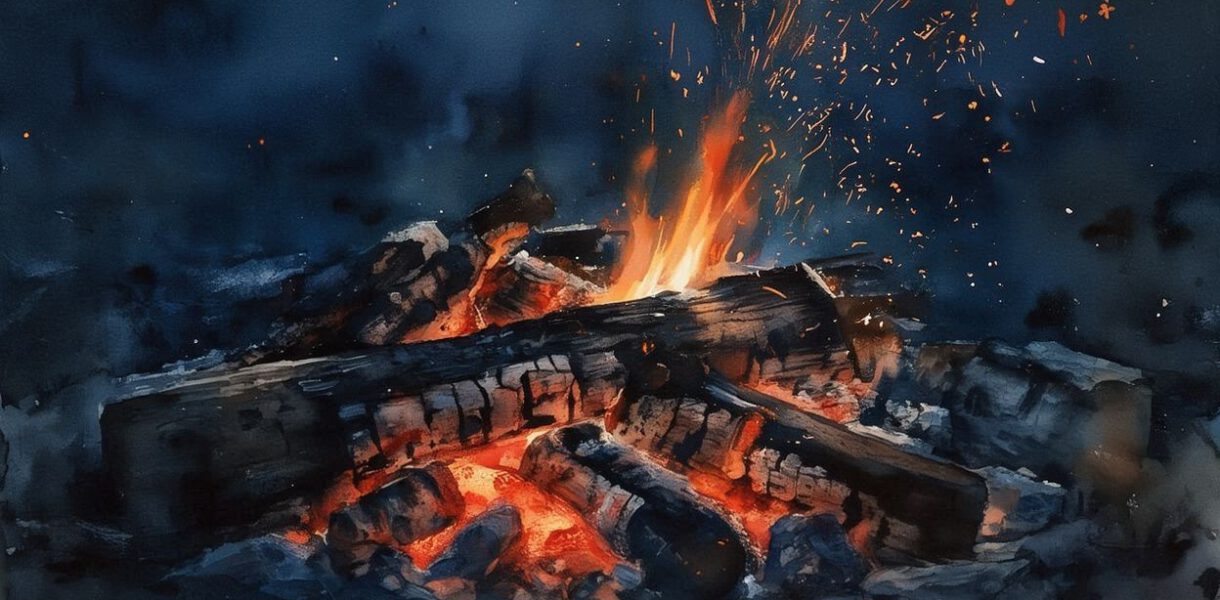
The lights grew brighter the closer they came, and soon Eva and Lennar could make out the outlines of a small village nestled in a hollow, its houses pressed together in a half-moon shape. The buildings had seen better days but were unharmed: thatched roofs, clay walls, ancient lintels carved with house blessings that gleamed silvery in the moonlight. On the village square a small fire burned, and in its dim glow people were standing and sitting around it.
As they took their first steps onto the square, shock shot through those gathered like an electric current. Many jumped to their feet: farmers, women in work clothes, even the elderly rose from the fire and came toward them. Two young lads grabbed the scythes that had been leaning against a house wall. Eva and Lennar found themselves staring into hard, hostile faces.
“Who are you?” a woman called out to them.
“We’re not pirates,” Eva said quickly.
“Anyone can say that,” someone muttered.
“They look far too neat for that,” someone else whispered.
Eva raised her hands. “Good people – we are members of the Order of Pilots. The village elder of Dreybergen, Gunhild Vargen, has summoned us to aid in defending you against the vile attacks your island has been suffering for some time.” A murmur went through the crowd. “The Order?” the woman repeated, studying Eva more closely. “Then step into the light, you two. We must be sure.”
When they came closer and their uniforms and the Order’s insignia became visible in the firelight, the tension melted away completely. Some of the children darted forward from behind adult legs. A man fetched two wooden stools and set them by the fire. “Sit down!” someone called. “You must be freezing!” came another voice. “We’ve still got mead and stew, cooked fresh today.”
The smell of rich broth and roasted vegetables hung in the air, mingling with the sweet aroma of warm mead. Eva and Lennar sat down, gratefully accepting cups and bowls, and warmth began to seep into their exhausted limbs.
As they ate, more and more people gathered around them. Children pressed especially close and pelted them with questions. Eva answered as best she could, but when the village headwoman barked a firm order for the high guests to be left in peace to eat and drink, everyone fell politely quiet, and Eva silently thanked her for it. The mead and stew did their work; she felt full, warm, and tired. The children soon found a new target for their attention, and before long they were all clustered at the feet of an old man sitting on a three‑legged stool by the fire. He had hardly any hair left on his head, weathered skin, a beard like dry felt, and eyes that sparkled with mischief.
“Grandpa! Grandpa! Tell us something!” a girl called.
“Yes, a story!” the others chimed in.
“The one about the rye wolf!”
“No, Lady Midday!”
“Both! Both!”
The old man snorted in mock annoyance and shifted on his stool. Then he raised a thin finger and traced little circles with its tip in front of the children’s faces until they were wriggling with laughter. “Listen closely,” he rasped. “These are stories best told in the daytime. Not at night, when the shadows grow long – and certainly not on a full‑moon night like this one.”
The children fell silent at once and hung on his every word. The adults moved closer too; even the young men ended their conversations and turned toward the old man. Then the grandfather began his tale:
“I am about to tell you of a creature as old as the grain itself, older even than your grandmothers’ grandmothers. It roams the fields in the heat of summer and on full‑moon nights, when the crops stand tall and all you see is stalk upon stalk. It is the rye wolf I’m going to tell you about. I am eighty years old, and my grandfather was just as old when he told me of it, back when I was your age. The rye wolf is no ordinary wolf, you see. It is a spirit of the wind, a demonic being that lives in the billowing waves of the grain. When the wind makes the ears roll in waves, that’s when you can see it running – right there where the crop bends as if pressed by an invisible hand. The howl of the wind, that piercing roar, that is its howl. Many have heard it without knowing what they were dealing with.”
Lennar and Eva exchanged a puzzled glance.
“The creature is gluttonous and has an insatiable hunger. It devours as much as the field can offer, and in its greed it gulps down more and more until it can hardly move from sheer overeating. With its jaws gaping wide it snaps at the ears of grain, and everywhere it sets its paws, the crop withers. My grandfather, a farmer just like I was one, told me that in bad years the rye wolf is especially savage. You know ergot, those black, twisted kernels that grow among the good grain – those are its work. That is why they’re called the wolf’s teeth.
And there is something more terrible still: whoever disturbs the rye wolf in its mischief, whoever ventures too close into the waves of grain, falls ill. My grandmother – the Lady may cradle her eternally – told me with a trembling voice that the souls of those the wolf had devoured – and yes, some children did lose their way in the tall fields – that their souls fluttered about in the trees like birds, restless and suffering, until the harvest was finally brought in. That was the worst of it: not death itself, but the restlessness that followed, that being trapped between worlds.”
Over her shoulder Eva could see the outer fields stretching all the way to the edge of the village. Even from this distance she could make out the way the wind gently swayed the ears of grain in the silver moonlight. She shuddered despite herself.
“But we farmers are no fools,” the old man continued. “We’ve learned how to deal with that spirit. When we come to the last sheaf in the field, we know: the rye wolf is crouching in that final bundle. With every swing of the scythe it retreats further and further, until there’s nowhere left for it to go. We bind that last sheaf tight, pick it up and – now listen closely, for you all know this custom – we give the reaper a charge. We say to him: ‘You’ve got the rye wolf!’ And so he carries the demon away, back to the village, to the barn, where the wolf is imprisoned for a whole year, until the new sowing comes and it is reborn.”
The grandfather lowered his gaze. Someone tossed a stick into the fire. Sparks shot upward. One of the young men standing nearby let out a derisive laugh. “They’re just a bunch o‘ old stories, old man! Leftover from darker times. Only children still believe in such tales.”
The old man slowly raised his head and leaned forward, squinting to make out the speaker in the half‑light. “Just stories, you say? Just fairy tales? Let me tell you something, you unbelieving fellow, you who have seen so little in your few young years. The rye wolf is no less real than the wind itself. All those who lived on this land before us – they did not make it up because they were simple fools.
I myself have seen the wind sweep across my father’s fields and leave a trail of devastation behind, stalks torn and twisted as if some giant beast had run through them. And every farmer here can bear witness to that.” Murmurs of agreement circled the fire; many nodded. “What scholars today call air currents – we call the wolf. And you know what? Our words are older, truer, because they keep our fear alive, our respect for the forces stronger than we are. Without such stories we’d forget too quickly.”
He leaned back again and stared into the fire. “No, these are no mere tales. The rye wolf lives in the storm wind that sweeps across the fields. It sits in the ergot that grows among your grain and poisons you if you’re careless. And as long as we farmers of Goldendale exist, there will be harvests – and the rye wolf will not be dead.”