
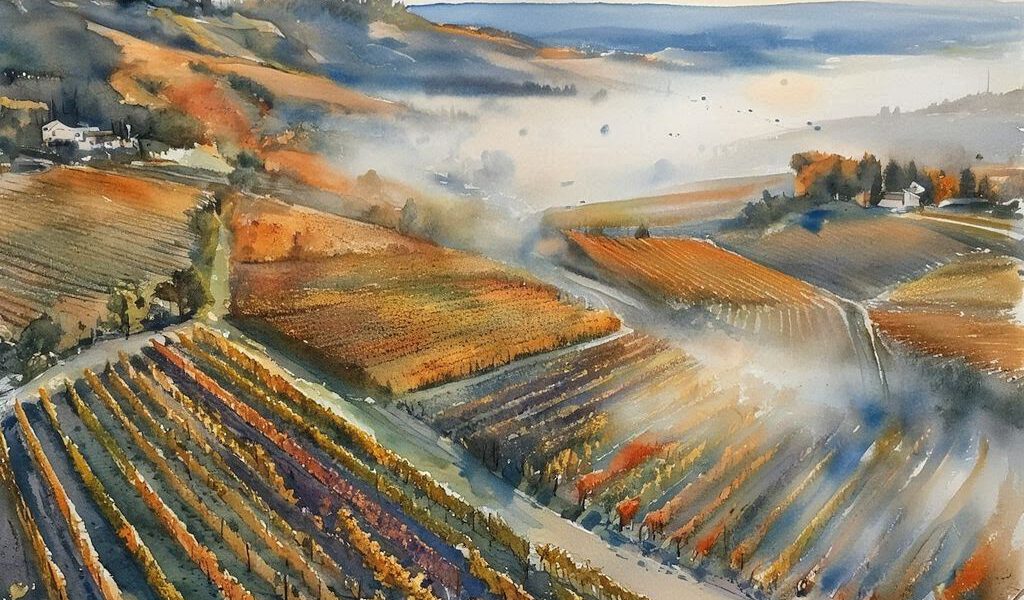
The sky was cloudless, but the clear coolness of the air gave evidence of autumn, which was about to bid farewell. Beneath Airis‘ feet, the last golden fields stretched out, with trees dotting the landscape here and there with splashes of orange and red. Small villages were shrouded in delicate veils of mist, with pointed church towers and windmills rising out of the haze. She flew over a ridge and a valley opened up before her, its slopes lined with neatly arranged rows of vines, behind which a large forest displayed a fireworks display of autumn colours. Airis let out a gasp of amazement. She loved the island of Goldendale, especially at harvest time. The wings of her self-built glider creaked as she began her descent. Now more details came into view.
Farmers at work, their carts filled to the brim with beets. Children playing in the stubble left behind in the harvested fields. On a threshing floor made of compacted clay near a settlement, she saw several women threshing. Their flails rose and fell, each blow sending fine golden particles into the air, creating a cloud of dust. Some women picked up the threshed material, threw it into the air and let the wind separate the chaff. Even from above, Airis could recognise the classic harvest costume of Goldendale: linen blouses, wide checked skirts that fell over sturdy boots, and bonnets that protected the hair, neck and face from dust and straw particles. Everyone working near the threshing floor had pulled a cloth over their mouths and noses. She heard shouts and horses neighing. She smelled the scent of charcoal kilns from the woods. She closed her eyes and enjoyed a moment of peace.
But she wasn’t here for pleasure. The Pilot Order had tasked her and several reconnaissance pilots with surveying the island from the air: The harbour authorities had reported several pirate sightings and did not want to take any risks. Airis pulled herself together and let her glider climb higher so she could get a better bird’s-eye view of the island. The winding paths between the fields, steep vineyards, small woods and network of villages lay before her like a colourful mosaic. In the distance, she saw her companions‘ ships flying in their rehearsed reconnaissance formation. They were heading towards the west of the island, where the agricultural landscape was now giving way to warehouses, marketplaces and fortifications. Goldendale was more than just a flying island with particularly fertile soil; it was the breadbasket of the cloud islands. The climate and mineral-rich soil were ideal for growing grain and fruit. Ever since records of the floating islands had existed, farmers had populated Goldendale and cultivated it with their families. Countless generations had dug up the reddish-brown earth, ploughed furrows, sown seeds, planted trees and felled them. They had built houses and carved sayings into their timberwork, such as ‘This house was built by Hans Vogel and Anna, his wife. May it offer protection from storm and fire. In the year of our Lady 1492’ or in the Old High Saxon dialect ‘This house is mine, yet not my own, the one before me called it home. He passed it on, I came to stay, And after death, I’ll go my way.’ They had given birth to children, celebrated name days and weddings, and burned their dead on modest wooden pyres. Not a single chronicle of Goldendale could be found in the great libraries – for no scholar had considered it important to document the banality of rural life. Thus, the history of the island remained an oral treasure of the families and was only reluctantly revealed to strangers.
At the westernmost edge of the island, the large pier rose into the sky, Goldendale’s most important connection to the outside world. Trading and transport airships lay on the mighty wooden pier, their sails billowing in the gentle autumn breeze, while dockworkers busily loaded crates, sacks and barrels. Next to it stood the warehouses, massive wooden structures with sturdy gates, where grain and other supplies were stored for the coming months. The flags of the merchant guild fluttered in the wind, their colours shining like small splashes of colour among the autumn tones of the fields. Airis could see people bustling between the warehouses, stacking crates, rolling barrels, lashing sacks and preparing cargo for the ships. Dockworkers ran towards a cruiser that was just mooring, while others supervised the loading of the ships. From the sky, the contrast between the bustling harbour area and the quiet, almost dreamy rest of the island was particularly striking.
Airis let her glider climb higher, her eyes fixed sharply on the horizon. The golden fields and the roofs of the warehouses lay peacefully below her, hardly any sounds reaching her. From time to time she picked up her binoculars. Suddenly her gaze was caught by a dark spot, at first little more than a shadow. It quickly took shape as a sailing ship. Her heart beat faster. This flying object moved differently, more nimbly, more purposefully. A shiver ran down her spine as she realised that this was no merchant ship. No light signals, no familiar colours – just a menacing black silhouette approaching at alarming speed. She recognised the manoeuvre immediately: there was no plan to land here; the hull was already turning to the side to optimally align its guns. Now she could see the blood-red sails even without binoculars. Pirates! The other scouts seemed to have spotted it too, because her glider’s signalling system emitted a shrill beep.
In a flash, she grabbed the radio: ‘Island guard! Come in!’ There was a crackle, then she heard a female voice. ‘Goldendale Harbour Division listening.’ Airis‘ voice trembled as she relayed the information. „This is Airis Dornhain, scout C.A.F. 12th cycle. Pirate ship approaching from the north. Estimated speed over 20 knots. Initiate defence immediately!“ But no sooner had she delivered the message than she felt a tremor in the air. Just a heartbeat, a blink of an eye, then the entire Goldendale defence system went up in a fireball.